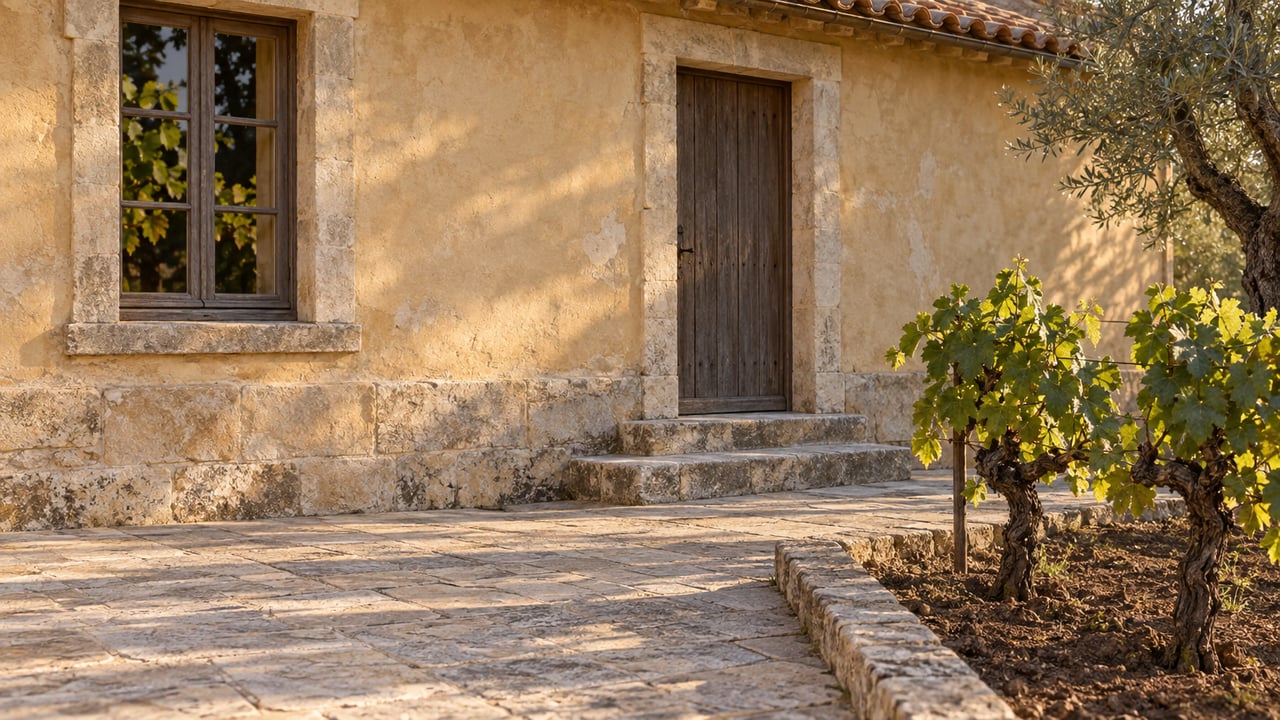
Rutherford Vineyards Now Pay a Groundwater Fee St. Helena Estates Don't
October 1, 2026
October 1, 2026
"We're really kind of late to the game across the board," Napa County's natural resources manager Jamison Crosby told the Board of Supervisors this past December, pointing out that Sonoma County has been charging its own groundwater pumping fee since 2021. Six weeks earlier, Napa hadn't charged one at all. On December 9, 2025, the Napa County Groundwater Sustainability Agency voted to catch up, adopting a new fee that starts showing up this fall on property tax bills across the Napa Valley Subbasin, the stretch of valley floor that runs roughly from south of the city of Napa up through Calistoga.
For a vineyard owner in Rutherford, this fee isn't a rumor to watch for. It's already built into the county's records of your parcel, and whether you owe it at all depends on a line that has nothing to do with soil, appellation, or what's planted in the ground: whether your address sits inside a city's water system or outside it.
The county has been explicit about where the fee applies. Properties served by the municipal water systems of the cities of Napa, St. Helena, and Calistoga, and the Town of Yountville, are not subject to it. Everywhere else inside the subbasin boundary is.
Rutherford has no city government and no municipal water utility of its own. Neither does Oakville. Every planted acre there sits inside the subbasin with no exemption to claim, which means two vineyards farmed identically, on comparable soil, a mile apart, can end up on opposite sides of this fee for a reason that has nothing to do with the wine. One happens to fall inside a city's service area. The other doesn't.
The number that circulated when the fee was first adopted was a ceiling, not a bill. The Board approved maximum rates in December 2025, then revisited them in August 2026 and cut them by roughly 55 percent for the first year, using money from the agency's own savings to soften the launch.
| User type | Ceiling rate (adopted Dec 2025) | First-year rate (approved Aug 2026) |
|---|---|---|
| Agricultural, dry-farmed or non-groundwater irrigation | $38.58 per planted acre | $17.53 per planted acre |
| Agricultural, groundwater-irrigated (total) | $98.74 per planted acre | $44.44 per planted acre |
| Self-supplied residential well | $62.58 per parcel | $28.17 per parcel |
| Public water system | $129.87 per acre-foot | $58.47 per acre-foot |
For a 15-acre irrigated Rutherford vineyard, the ceiling rate would have meant an annual bill near $1,481. The rate that will actually appear on this year's tax statement runs closer to $667. Both numbers describe the same parcel. Only one of them shows up on the bill, and it's the smaller one, at least for this fiscal year.
The fee also splits on farming method, not just location. Land irrigated with groundwater pays the full rate. Land that's dry-farmed, meaning it relies only on rainfall stored in the soil rather than supplemental irrigation, pays just the base rate with no surcharge. Napa County's own definition follows the California Sustainable Winegrowing Alliance standard, and qualifying required the property owner to notify the Groundwater Sustainability Agency by July 10, 2026, with documentation of which acreage is dry-farmed.
That deadline has already passed for this cycle, but it resets annually, and it matters for due diligence. A seller who dry-farms part of a Rutherford parcel and filed the paperwork on time locked in the lower rate for that acreage. A seller who didn't file, or who irrigated during establishment years and hasn't formally transitioned, is still being billed at the higher irrigated rate regardless of current practice. The property's farming history and its paper trail with the county are now two different things, and a buyer needs both.
The reduction wasn't automatic. When the ceiling rates were adopted in December 2025, the vote split 3-2, with Supervisors Liz Alessio and Anne Cottrell pushing for a slower phase-in. Alessio pointed to what she was seeing along the valley's main roads, describing mounds of vineyards that had to be pulled. Napa Valley Vintners' Michelle Novi told the Board that having the fee arrive now was very difficult for the industry to weather. Winegrowers of Napa County's Michelle Benvenutto asked the county to be a true partner in helping absorb the cost, and Napa Valley Grapegrowers' Caleb Mosley noted that rising costs and sustained economic pressures make additional assessments hard to absorb.
Some of that backdrop is measurable. Napa County had roughly 42,400 acres of planted vineyard as of the fee discussions, and supervisors cited more than 3,100 acres pulled between October 2024 and August 2025. By August 2026, the Board agreed to draw $750,000 from the agency's own fund balance to bring first-year rates down, which is why the number on this fall's bill is well below what was adopted eight months earlier. Whether that reduction repeats next year depends on the agency's budget, not on anything a buyer can lock in today.
The fee is small enough on most parcels that it won't change whether a purchase makes sense. It's specific enough that skipping the check is a mistake, especially since it's the kind of recurring cost that doesn't show up on a listing sheet and only becomes visible once the tax bill arrives.
Before closing on vineyard or estate land in Rutherford, or anywhere else in the subbasin, it's worth confirming:
Is this a new property tax? The county describes it as a fee, not a tax. By law it can only fund groundwater monitoring, reporting, planning, and compliance work, and it can't be used for unrelated county services, even though it will appear as a line item on the property tax bill.
Will next year's rate look like this year's? Not necessarily. This year's reduced rates were made possible by drawing down the agency's savings. Future years depend on the agency's budget and could move in either direction.
Does every parcel in Rutherford pay the same amount? No. The bill depends on planted acreage and on whether that acreage is irrigated with groundwater or dry-farmed, so two neighboring vineyards of the same size can carry different annual costs.
A new fee tied to a boundary you can't see from the road is exactly the kind of detail that belongs in a due diligence conversation, not a surprise after close. If you're evaluating a Rutherford vineyard or estate purchase and want help reading a specific parcel's groundwater status, farming certification, and what that means for your carrying costs, Wine Country Consultants can walk through it with you. Schedule a confidential consultation before you make an offer.

We are a family real estate firm focused on legacy vineyards and wineries. Our unique approach to buying and selling properties highlights a deep understanding of the historical importance every property holds as well as its potential in today’s market. Contact us today to find out how we can be of assistance to you!