Calistoga Vineyard Values Compared With Rutherford and Oakville
July 23, 2026
July 23, 2026
Three days before this piece went to draft, Napa County closed one of the most instructive winery disputes of the decade. The Castello di Amorosa settlement with Water Audit California brought a quiet end to a permit saga in which the winery successfully sought to legalize several use permit violations, including hosting 427,541 annual visitors instead of the approved maximum of 25,000, a 1,600% increase. For a buyer cross-shopping vineyard acreage in Calistoga against Rutherford, Oakville, or St. Helena, that number is not gossip. It is the clearest recent evidence that the price of a Calistoga vineyard is set less by soil profile than by the line on the map that separates city jurisdiction from county jurisdiction, because that line determines whether hospitality revenue can ever sit on top of the farming operation.
That is the argument of this post. The median tells you almost nothing here. The entitlement path tells you almost everything.
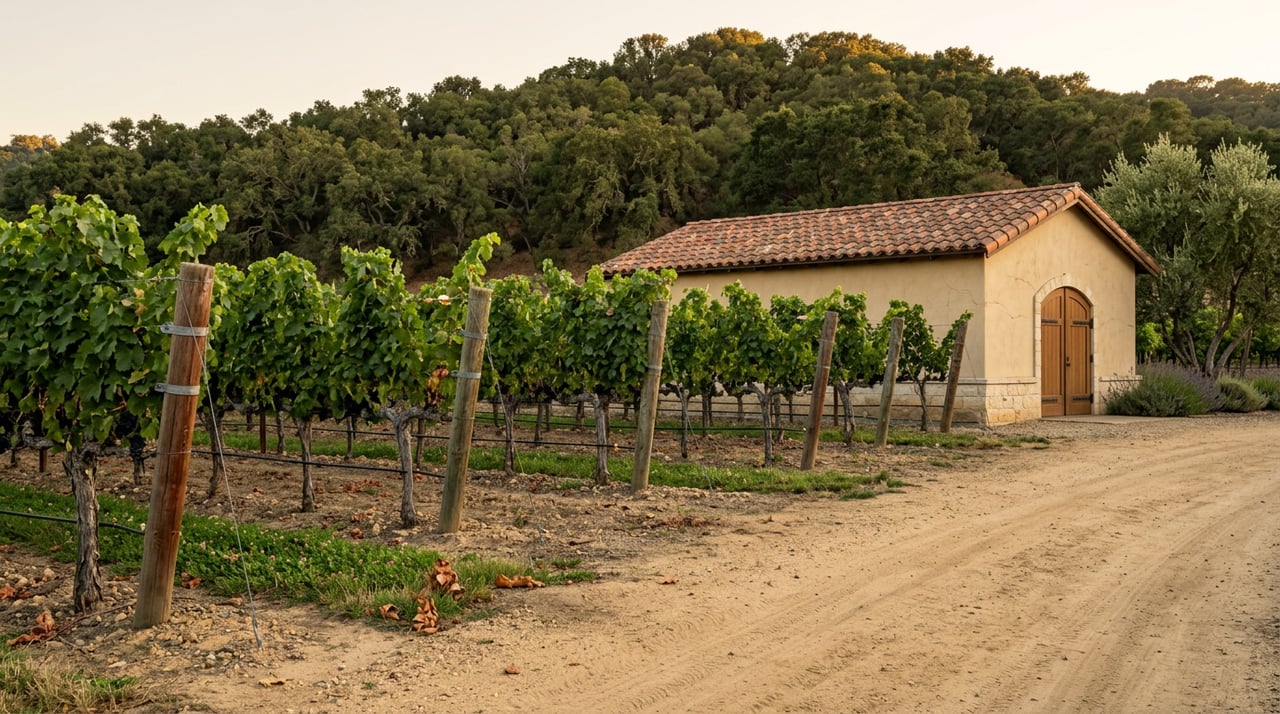
Calistoga sits at the warm northern end of Napa Valley. It covers approximately 8,000 acres, with a mix of valley floor and hillside vineyards, a warm Mediterranean climate, and hot summer days and cooler evenings well suited to ripening Cabernet Sauvignon. Compared with Rutherford or Oakville, the footprint is small, the plantings skew red, and hillside exposure varies sharply parcel to parcel. Those facts set a floor on quality. They do not set the price.
Every parcel in the AVA falls into one of two regulatory worlds, and the two worlds price differently.
| Question | Inside Calistoga city limits | Unincorporated Napa County |
|---|---|---|
| Governing rules | City zoning, design review, General Plan | Napa County Winery Definition Ordinance and use permit |
| Tasting rooms and lodging | Possible with city entitlements | Tightly capped by WDO conditions |
| Weddings and social events | Case by case under city code | Generally prohibited for wineries permitted after 1990 |
| Timeline and cost to entitle | Faster, smaller | Two to three years, $25,000 to $50,000 in county fees before consultants |
| Downside enforcement risk | City code | County audit and appeal exposure |
The county side is the harder read. Unincorporated parcels follow the county's Winery Definition Ordinance and use permit process, which sets parameters on visitor counts, events, and marketing activities, and WDO decisions shape permitted visitation. This city-versus-county split is a major driver of feasibility if you want on-site tastings, a small bonded winery, or guest services. Obtaining a use permit from the county might take two to three years from the time of application, and the cost paid to the county might be $25,000 to $50,000, before the applicant hires land use consultants, hydrologists, and biologists.
That timeline is the friction. A parcel with a mature, current use permit for a bonded winery and a defined visitation cap trades at a premium. A raw hillside parcel with theoretical hospitality potential trades at a discount that reflects the years and dollars a buyer will spend to find out whether the theory holds.
Public data on Calistoga right now looks bearish. The average Calistoga home value is $1,034,270, down 4.9% over the past year according to Zillow's index, and Redfin's May 2026 read shows a median sale price of $949,432, down 7.6% year over year. Local brokerage feeds show the April 2026 median closer to $1.72M with 49 sales in the month and 63 days on market. Those three numbers describe the residential market, and they do not translate to vineyard land.
The vineyard market runs on a different denominator. As of mid-2026, listings show 14 vineyards for sale near Calistoga, with an average listing price of $12,230,444 and an average cost to buy of $310,996 per acre. That per-acre figure is the one a cross-AVA shopper should hold up against Rutherford and Oakville comps, not the single-family median. It is also the number that moves when a permit is attached to the dirt.
Calistoga's DTC economics are not built on drive-by traffic. They are built on hotel guests already inside the AVA looking for a tasting slot within a five-mile radius of their room. The anchor is now unambiguous. The Four Seasons Resort and Residences Napa Valley at 400 Silverado Trail sold from Alcion Ventures to Sunstone Hotel Investors for about $175 million, and the price of $2.1 million per key would amount to the second-biggest U.S. hotel deal ever, surpassed only by Hyatt's acquisition of the Ventana Big Sur resort at $2.5 million per key. That transaction repriced the ceiling for luxury hospitality in the AVA in a way no vineyard sale could.
The resort matters for vineyard valuation for a specific reason. Four Seasons Resort and Residences Napa Valley is set within a working organic vineyard in the Calistoga AVA, with a grape-to-glass journey at Elusa Winery. Combined with Solage, Indian Springs, and nearby producers like Castello di Amorosa and Chateau Montelena, the concentration of high-spend visitors within the town's walk-and-shuttle radius creates asymmetric demand for appointment-only allocations from small bonded producers. A 3,000-case brand inside the AVA that can host thirty guests a day by appointment captures a different margin than the same brand shipping into three-tier distribution.
The counter-example is instructive. The county lost Calistoga Ranch in the 2020 Glass Fire, which was able to host weddings as a resort under the local hotel permitting rules. That inventory has not returned, and the scarcity of resort-permitted parcels is why the Four Seasons number cleared where it did. For a vineyard buyer, the takeaway is not to chase resort permits. It is to recognize that the resorts do the heavy lifting on visitor draw, and a well-positioned small producer does not need to build a spa to benefit from one.
The clearest current comp on the vineyard side is 1090 Bale Lane, offered at $7.9 million, a 28-acre property in the heart of the Calistoga AVA that includes approximately 17.6 planted acres of Cabernet Sauvignon, with vines reaching full production in 2025 and projected yields of 5 to 5.5 tons per acre. Do the math the way an operator would. At 5.25 tons per acre across 17.6 planted acres, that is roughly 92 tons of Calistoga Cabernet fruit. Contract prices for AVA-designated Cabernet at that quality tier fluctuate year to year, and USDA's California Grape Crush Report is the reference to check before underwriting. The point is that at $7.9M, the buyer is pricing the fruit stream, not the hospitality option. If the parcel also carried a small bonded winery permit with a meaningful visitor cap, the same dirt would clear at a different number.
Before you fix a value in your head, work through these:
Does a Calistoga vineyard need a winery on it to be worth owning? No. Many parcels function as pure agricultural assets, either farmed by the owner and sold to a producer or leased to a third-party vintner. The decision is a function of the buyer's time, capital, and appetite for the entitlement path.
How does Calistoga price against Rutherford or Oakville per planted acre? The Calistoga AVA generally clears below trophy Rutherford and Oakville Cabernet acreage at the top of the market, though hillside sites with distinctive exposure narrow the gap. The bigger driver of variance within Calistoga is the permit stack sitting on the dirt, not the AVA line.
Can I run a wedding venue on a Calistoga vineyard? Not on a winery parcel permitted after 1990 under Napa County rules. The county has interpreted its ordinance so that wineries approved for business after 1990 may not host cultural and social events because weddings are considered commercial uses not involving education about wine. Resort-permitted parcels are a separate category and are rare.
What changed with the Castello di Amorosa settlement? The case did not change the WDO. It changed the visibility of enforcement. Any buyer underwriting a Calistoga winery in 2026 should assume that visitor logs, event counts, and marketing activities will be audited against the specific numbers on the use permit, and should price compliance work into the deal.
Legacy vineyards and operational wineries in Calistoga rarely trade on the open market, and the ones that do reward buyers who read the entitlements before they read the soil map. If you are weighing a Calistoga acquisition, or considering a confidential sale of a vineyard or winery estate in the AVA, Wine Country Consultants offers a discreet, technically grounded assessment drawing on more than thirty years of viticulture property experience and the global reach of our Christie's International Real Estate affiliation. Schedule a confidential consultation.

We are a family real estate firm focused on legacy vineyards and wineries. Our unique approach to buying and selling properties highlights a deep understanding of the historical importance every property holds as well as its potential in today’s market. Contact us today to find out how we can be of assistance to you!