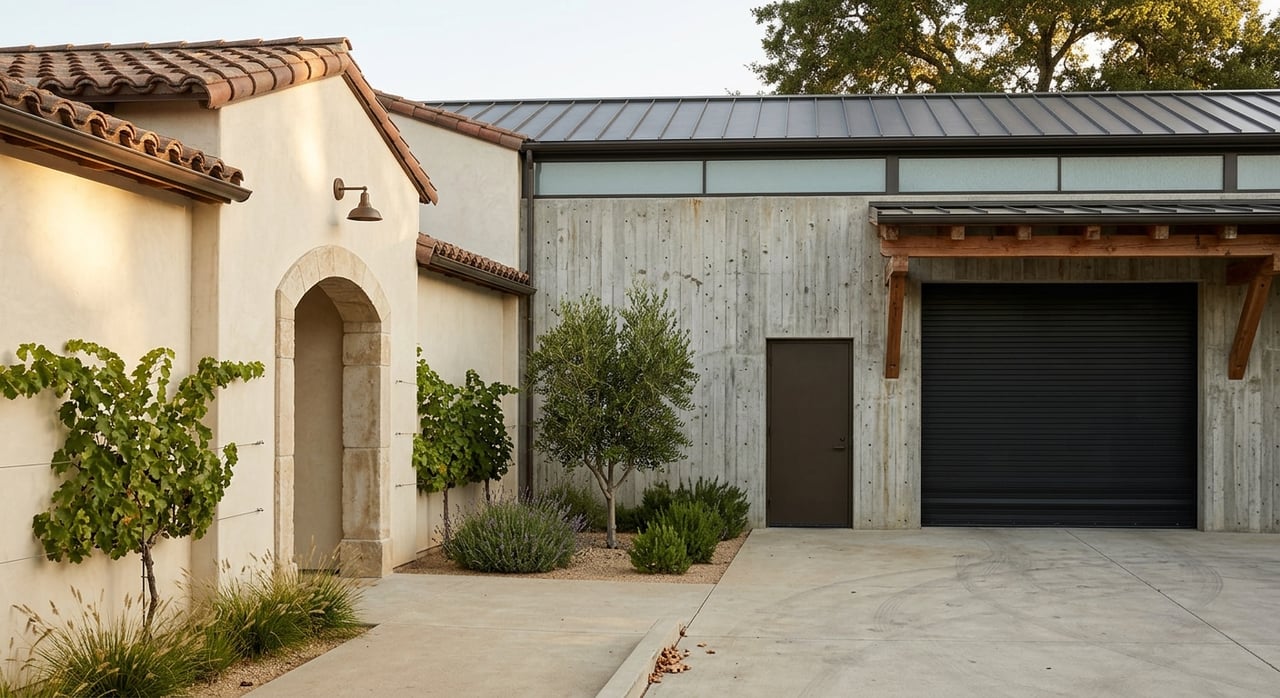
Choosing Between a Napa Production Facility and Estate Winery
April 23, 2026
April 23, 2026
If you are weighing a Napa production facility against an estate winery, you are really deciding how you want your business to operate, grow, and eventually transition. In Napa, that choice carries extra weight because land use, visitor demand, grape sourcing rules, and permitting all shape what is practical. The good news is that each model can work well when it matches your goals. Let’s break down how to choose the right fit for your next move.
Napa is not just a wine region. It is also a major visitor economy. According to Visit Napa Valley research, the county welcomed 3.7 million visitors in 2023, generated $2.5 billion in visitor spending, and supported about 16,000 jobs.
That tourism base matters because it can strengthen direct-to-consumer sales, hospitality, and brand exposure. At the same time, Napa is governed by detailed land-use rules that treat winery production and visitor activity very differently depending on where a property sits. In other words, your real estate choice is also an operating strategy.
A production facility is typically focused on making, storing, and shipping wine efficiently. In Napa, this model often fits more naturally in city industrial or corporate park settings, where the land-use framework can support manufacturing, warehousing, office, hotel, and winery uses, with winery use allowed by condition in some industrial districts, according to City of Napa planning documents.
For many buyers, this model is about operational clarity. You may be able to use an existing industrial shell, reduce the amount of hospitality infrastructure needed, and avoid buying vineyard land if ownership of planted acreage is not central to your strategy.
A production facility may be the better fit if you want to prioritize:
This path can also make sense if you plan to separate production from hospitality. The City of Napa notes that many county wineries increasingly look to the city for tasting-room experiences because on-site visitor capacity in the county is limited.
An estate winery is a more integrated real estate and business model. It usually combines vineyard land or planted acreage, winery production facilities, and some level of on-site visitor experience within Napa County’s agricultural setting.
Under Napa County land-use rules, a winery is an agricultural processing facility used for fermenting and processing grape juice into wine, or refermenting still wine into sparkling wine. The county framework also makes clear that tours and tastings are generally by prior appointment only, and food service must remain incidental so the winery does not function as a café or restaurant.
An estate winery may be the better fit if you want to prioritize:
For buyers who want a long-term Napa presence, this model can offer a compelling combination of operational control and place-based identity. It can also support the kind of estate narrative that resonates with collectors, club members, and future buyers.
In Napa County, the entitlement structure matters as much as the property itself. If you are pursuing an estate winery, you need to understand early how county rules may affect sourcing, use, and scale.
One of the most important rules for newer wineries is the county requirement that at least 75% of the grapes used to make still wine, or the still wine used for sparkling wine, be grown within Napa County, as outlined in the county code. That makes vineyard control, grower relationships, or grape contracts a central issue if you are considering the estate route.
Hospitality in Napa County is not unlimited. Tours and tastings are typically appointment-based, and food service must stay secondary to the winery’s agricultural use. That means the romantic idea of a highly active hospitality venue may not line up with what a specific entitlement actually allows.
This is one reason many operators think carefully about a split model. Production may happen in one location, while tasting and consumer engagement happen in a city setting that better suits that activity.
One of the biggest practical differences between the two models is how much capital and permitting work they usually require.
An estate winery often involves a full stack of improvements. Recent Napa County project descriptions show the range clearly: production facilities, hospitality buildings, covered crush pads, parking lots, access-road upgrades, wastewater treatment systems, left-turn lanes, and large fire-suppression tanks.
By contrast, a production facility can sometimes be created within an existing industrial framework. While every property is different, that can reduce the need for vineyard acquisition and major hospitality build-out.
Napa County’s winery-use application materials show how detailed the process can be. Applicants are asked to schedule pre-application review and submit narratives and plans covering roads, parking, wells, septic systems, water storage, utility lines, employees, visitation, and marketing activities.
The county also notes that fees may be based on actual time and materials or flat-fee deposits. In simple terms, the more complex the project, the more time and cost you should expect in the approval process.
If you are evaluating a smaller winery concept, Napa County’s micro-winery framework provides a useful reference. That category is capped at 5,000 gallons of annual production, 5,000 square feet of enclosed space, and 20 average daily trips from visitors, employees, and deliveries, with no marketing events allowed.
Even if your project is larger, those limits help illustrate how tightly Napa links entitlement intensity to operating intensity. Scale is never just about square footage. It is also about traffic, staffing, infrastructure, and visitor impact.
Your channel mix should not be an afterthought. It should be part of how you choose the real estate in the first place.
According to SVB wine industry reporting, tasting rooms and wine clubs accounted for 53% of average winery sales in the 2026 State of the US Wine Industry report, and direct-to-consumer represented 72% of total sales for surveyed wineries in the 2024 DTC survey. That is a powerful argument for estate wineries and hospitality-driven models when direct customer relationships are central to your plan.
At the same time, SVB’s 2025 report notes that wholesale-heavy wineries fared worse than direct-focused brands, while tasting-room visitation was expected to be slightly lower in 2025. That combination suggests you should be realistic, not romantic, about your future revenue mix.
Before you choose a property, ask:
The right answer depends on your business model, not just your aesthetic preference.
A production-only model often simplifies the day-to-day operation. With fewer visitors, the property can function more like a manufacturing or warehouse site. That usually means less pressure around parking, access management, and visitor-facing staffing.
An estate winery generally has a larger operating footprint. Based on county project examples, traffic improvements, parking, wastewater systems, and fire-water infrastructure can become part of the entitlement and operational picture.
For some owners, that complexity is worth it because the hospitality and estate identity add value. For others, it creates a level of oversight that is not necessary if the real priority is efficient production and fulfillment.
A smart Napa acquisition plan looks beyond the purchase. It also considers future flexibility.
An estate winery often monetizes a bundle of assets: vineyard land, winery entitlements, hospitality use, and a place-based brand story. That can be powerful, but it may also narrow the buyer pool because the next owner needs the appetite and capability to operate a more specialized asset.
A stand-alone production facility may offer a broader exit path if it sits in city industrial or corporate-park zoning. Based on the City of Napa land-use framework, those properties may appeal to a wider range of users tied to manufacturing, warehousing, office, food, beverage, or logistics.
Market timing also matters. SVB’s 2026 industry report release describes the wine business as being in a multi-year demand correction, with estimated 2025 sales down 2.0% by cases and 1.6% by dollars.
That does not mean Napa opportunities disappear. It means underwriting should be disciplined. You want a property that works for your current plan and still gives you reasonable options if the market shifts.
If you are trying to simplify the choice, use this framework.
In practice, many serious buyers benefit from evaluating both paths side by side before they commit. The right answer usually becomes clear when you align location, entitlements, channel strategy, and long-term goals.
If you are considering a Napa production facility, estate winery, or a hybrid strategy, working with an advisor who understands vineyards, winery infrastructure, and entitlement context can help you avoid expensive mismatches. The team at Wine Country Consultants helps buyers and sellers navigate complex wine-country assets with discretion, local expertise, and a long view of value.


We are a family real estate firm focused on legacy vineyards and wineries. Our unique approach to buying and selling properties highlights a deep understanding of the historical importance every property holds as well as its potential in today’s market. Contact us today to find out how we can be of assistance to you!